Yamato Gunkei Chicken – Japanese Gamefowl
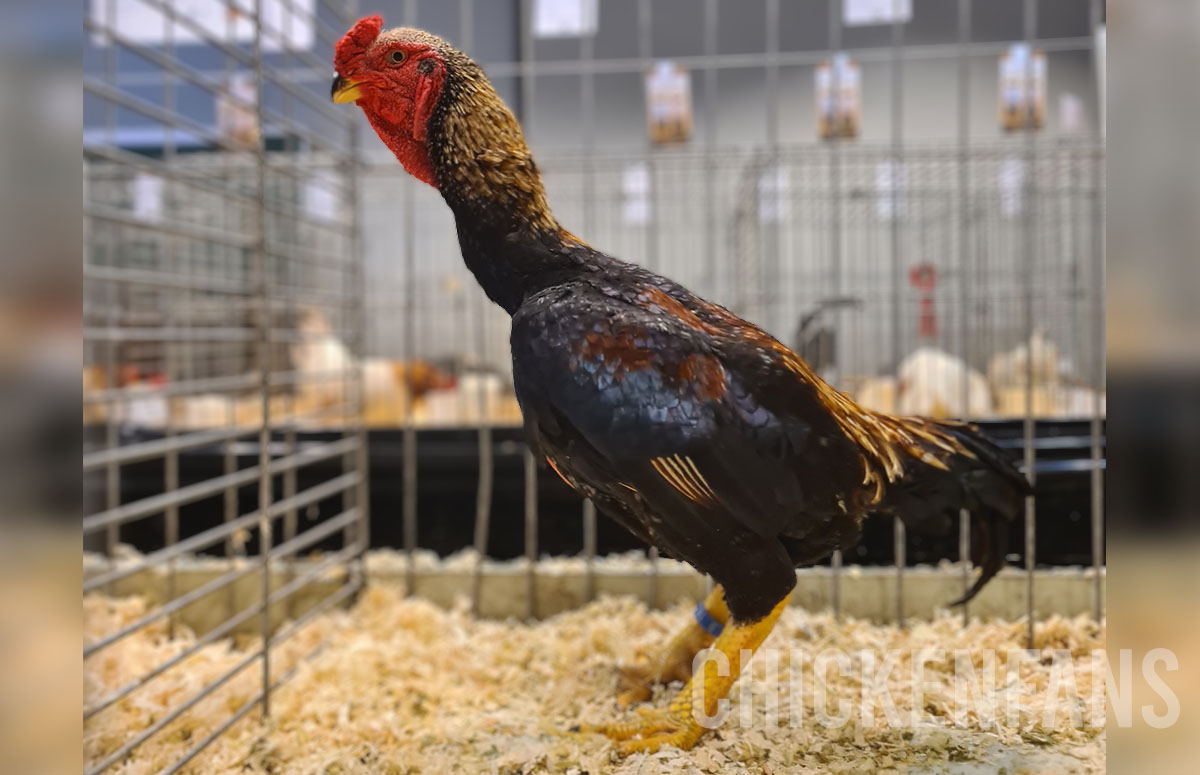
The Yamato (Yamato-Gunkei) is Japan’s compact game bird, the smallest of the Shamo chickens, built broad up front with a bold, upright stance, a wrinkled, meaty face, and tight, close feathering.
In Japan the Yamato Gunkei is a protected Natural Monument. It’s the short, stocky cousin in the Shamo family.
Some takeaways:
- Japanese Shamo-group game breed (Natural Monument grouping)
- Signature head: walnut (or pea) comb, heavy brows, pronounced dewlap
- Tail is short and shrimp-tailed
- Keel shows through because of tight feathering
- Kept as a specialist show bird
| Eggs | ~5–40 per year (very low) |
| Egg Color | White to tinted |
| Egg Size | Small–medium (around 35 g is typical on older European sheets) |
| Weight | Rooster 1.7–2.7 kg; Hen 1.3–2.25 kg (Japanese standard centers ~1.7 kg ♂ / 1.5 kg ♀; some Western lines run heavier) |
| Hardiness | Hardy; slow to mature |
| Temperament | Calm with people, pushy with other chickens |
| Beginner-friendly | No |
| Color | Black, black-red (BBR/wheaten hens), duckwing/silver, blue, ginger, splash, spangle, cuckoo, white |
Characteristics
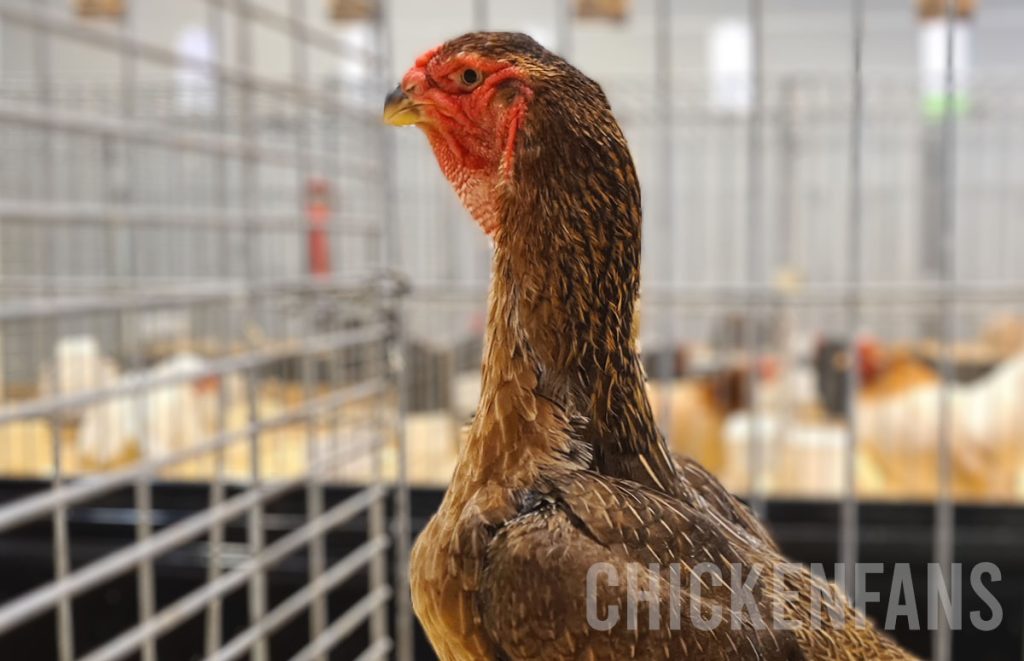
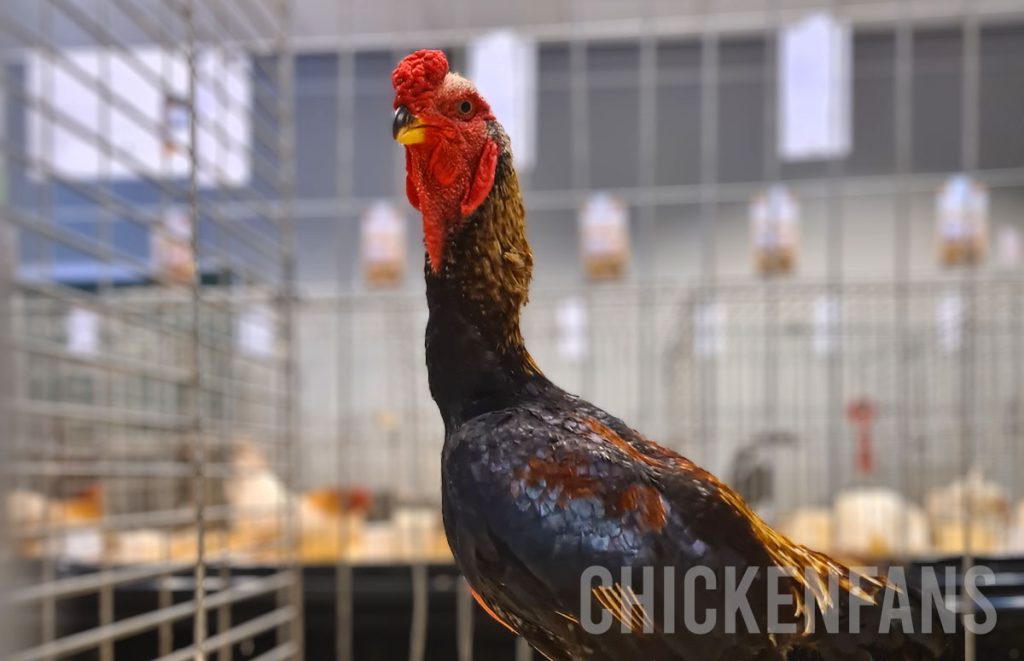
Yamato chickens are small, low, and wide gamefowl with an upright neck and a chest like a little bulldozer. Heads are short and broad with big eyebrow ridges. The face skin is abundant and heavily wrinkled, especially in older birds, and there’s a well-developed throat dewlap.
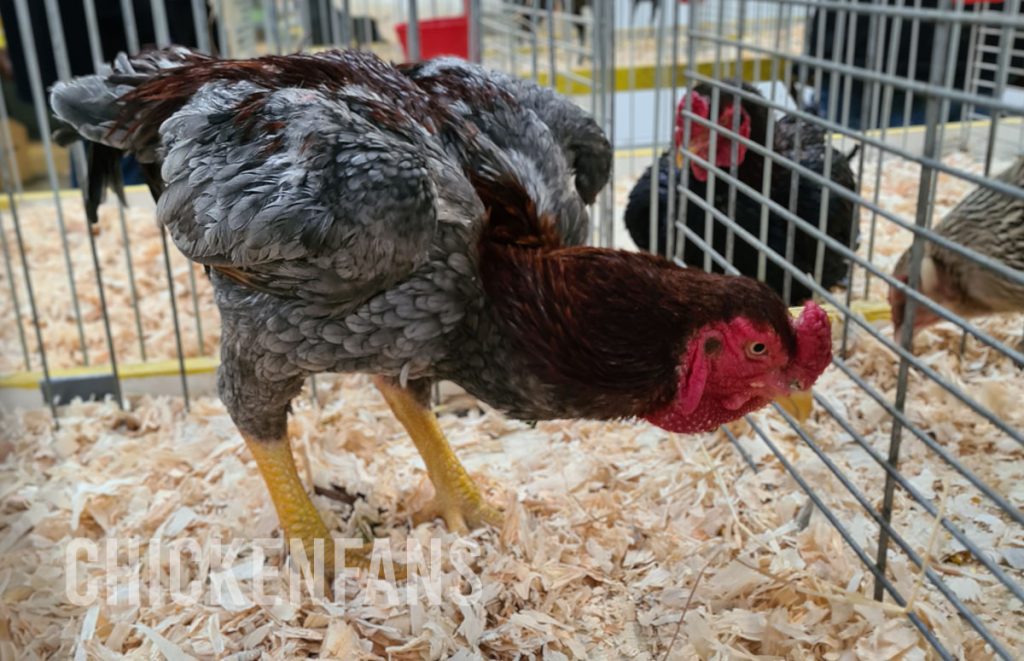
Walnut comb is standard, but some birds carry a pea comb (which is permitted by the standard). The earlobes are long, thick, and red, while the wattles are tiny.
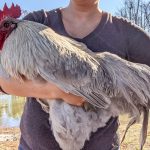
Adults have pearl-white eyes, but the eyes of younger birds can be yellowish, like the young rooster shown here. Beak and shanks are yellow. Wings are short and tight, the shoulder stands out, and the wing joint is bare.
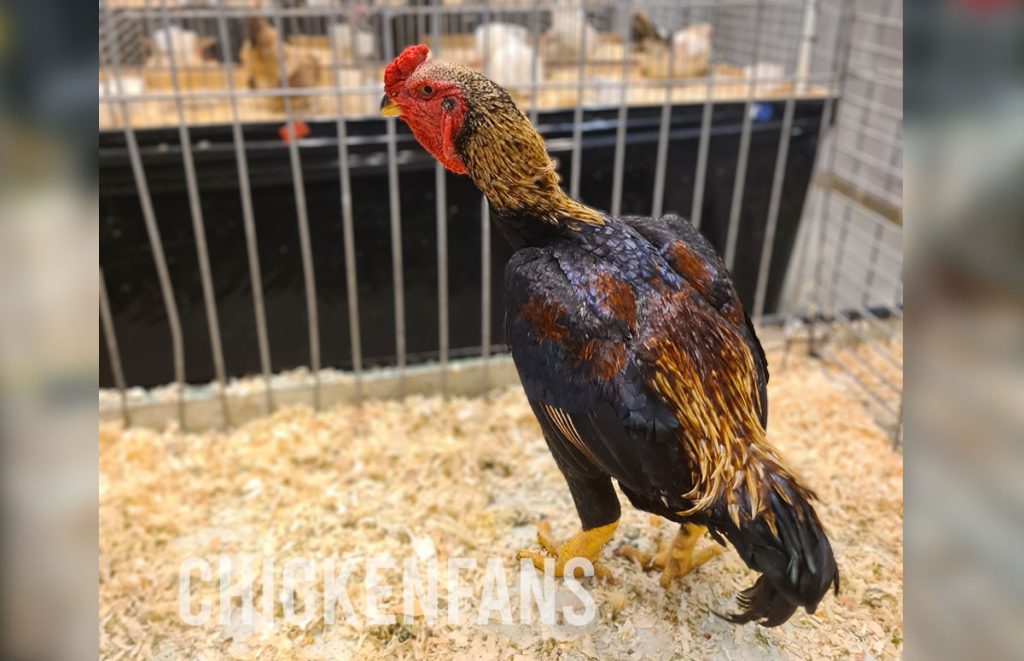
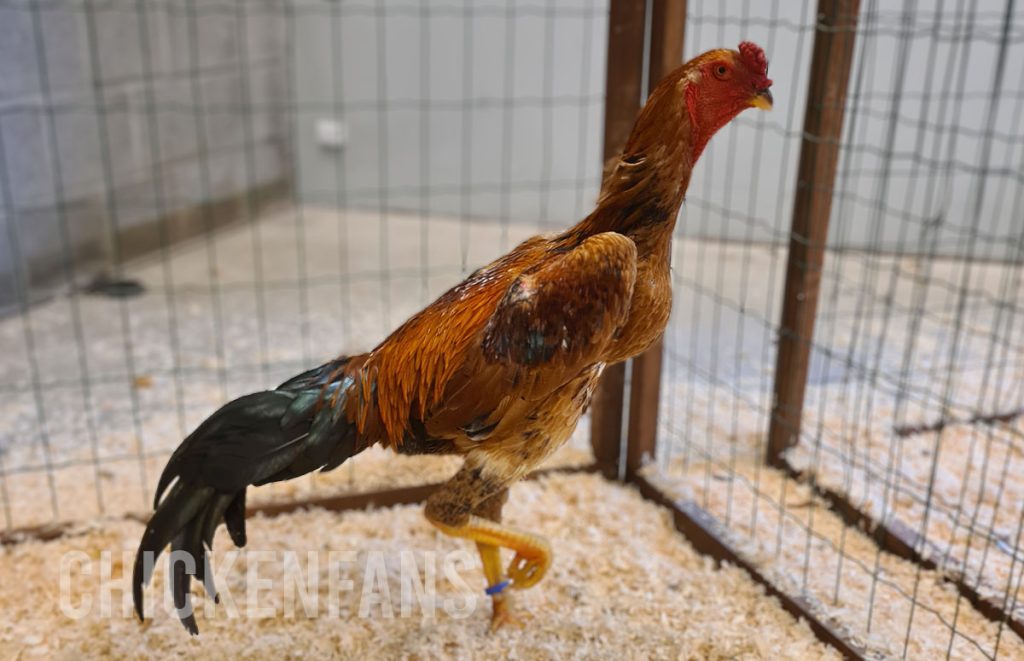
Tails are short and down-carried, with the lowest tail feathers curling upward over the short sickles. The classic shrimp tail. Feathering is very hard and close, so the breastbone/keel is often visible.
Colors
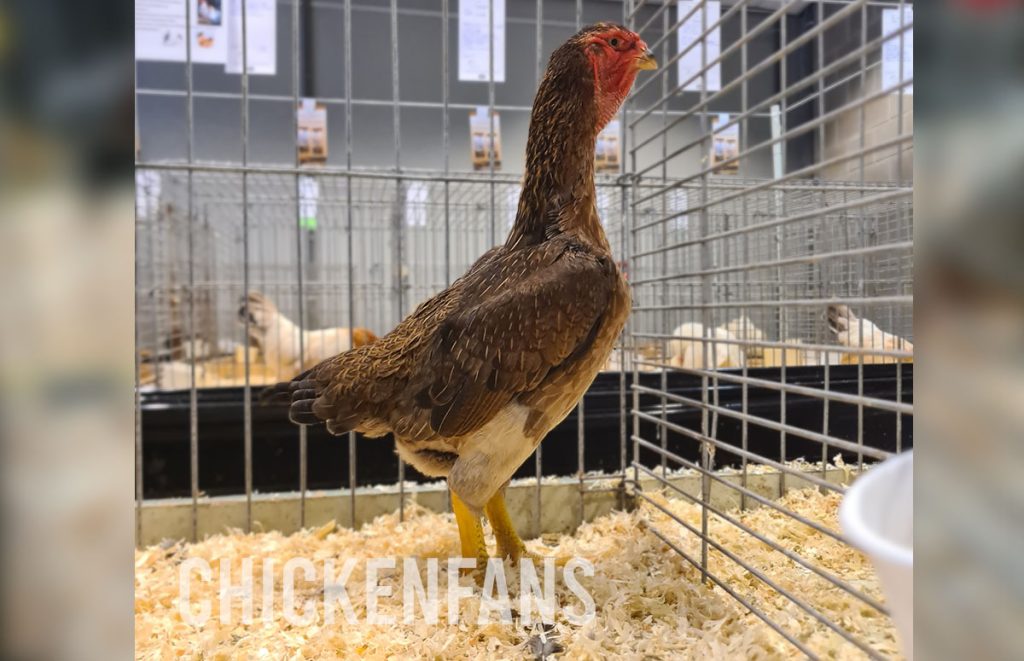
Yamato come in a wide palette: black, black-red (wheaten hens), duckwing/silver, blue, ginger, splash, spangle, cuckoo, white. In Europe (e.g. Belgium) you’ll also see blue-wheaten, wildtype, silver-wheaten, black-mottled, cuckoo, silver duckwing, blue duckwing, etc.
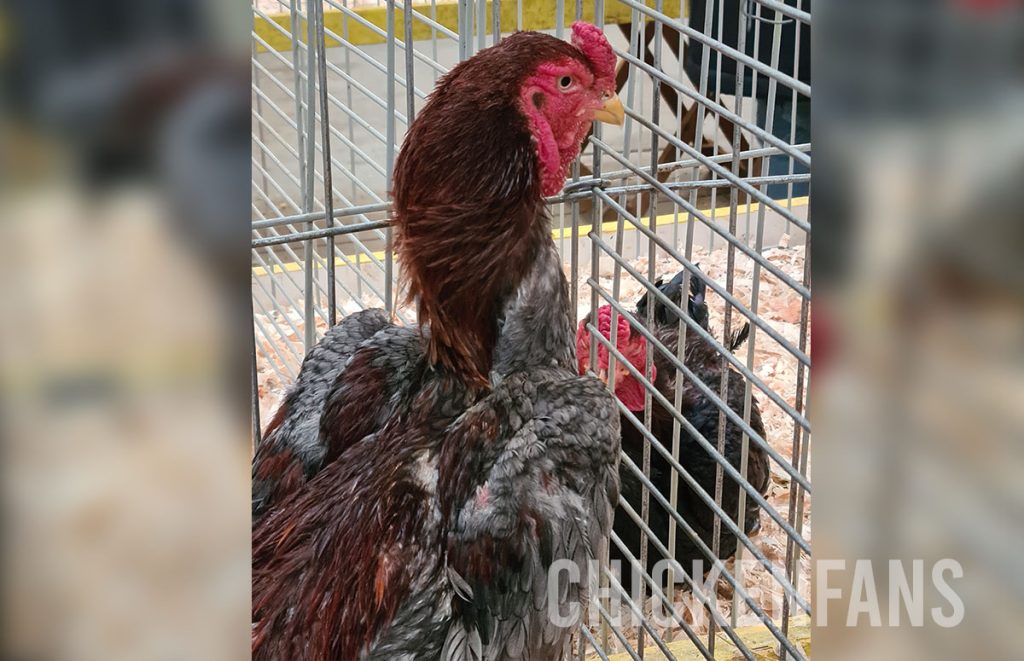
On the show bench, that many color varieties thin the classes and make apples-to-apples tough, so judges rank type first: carriage, breadth, hard feather, head/face, and condition.
Color/pattern is the icing, not the cake.
Egg Production
Yamato chickens lay very few eggs, think a handful to a few dozen a year.
The egg shells run from white to tinted and are smallish. This is normal for the breed. Fertility can be hit-or-miss, so breeders often work with pairs or trios and give them time. Oftentimes, breeders confine a rooster and hen in a tighter pen to coax them into pairing up.
Personality
Around people, Yamato chickens can be steady and almost stoic. However, around other chickens, they are competitive! They are fighters after all.
House males one per pen with their hens, and separate cockerels early. They’re not big flyers, but they do like space and simple, dry housing.
Categorization
In Japan, the Yamato-Gunkei is officially considered part of the Shamo group of native gamefowl (alongside O-Shamo, Chu-Shamo, Ko-Shamo, Nankin-Shamo, Echigo-Nankin-Shamo, and Yakido/Kinpa lines).
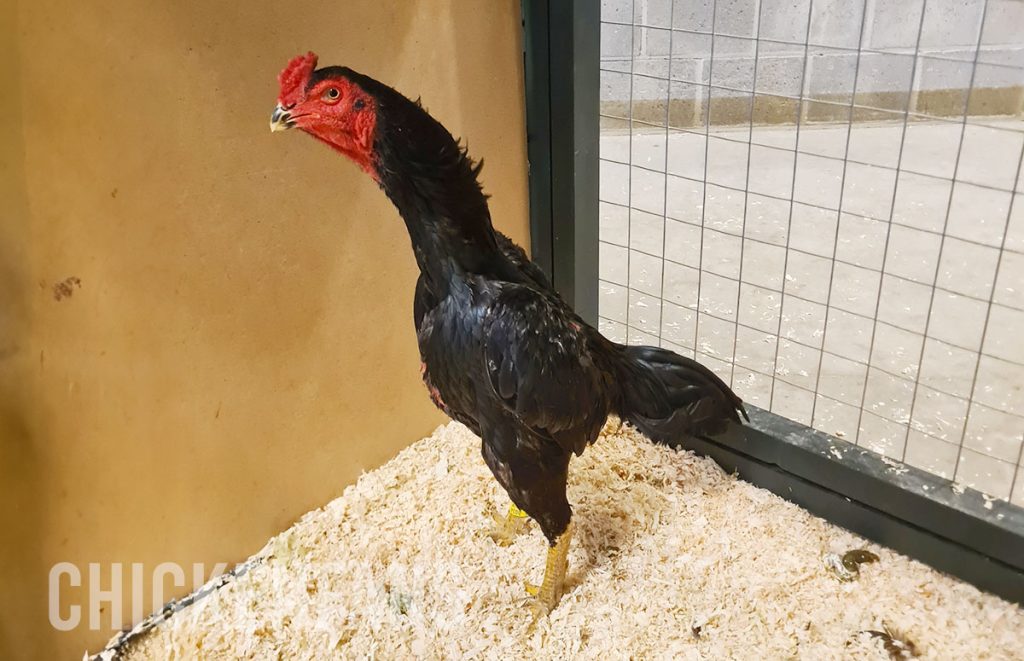
These were collectively declared Natural Monuments of Japan in 1941. Within that group, the Yamato is the compact, low, broad type. the Yamato-Gunkei is sometimes called the “bulldog of chickens.” European standards classify it under Asian Hardfeather breeds, and in Britain it is listed as a Large Fowl only; there is no bantam version.
The Yamato Gunkei Name
The name Yamato-Gunkei (大和軍鶏) carries both regional and functional meaning.
- Yamato (大和) is the old name for Japan’s cultural heartland around Nara, often used poetically to mean truly Japanese
- Gunkei (軍鶏) literally the kanji translates as “war chicken” or “gamefowl,” the same characters used for Shamo. Unlike the usual reading Shamo (しゃも), here the characters are read as Gunkei (ぐんけい), a deliberate distinction to mark this compact, wrinkled-faced variety within the Shamo group
Put together, the name underscores both its national heritage and its role as a fighting-type bird reshaped into an ornamental form.
It’s interesting to see that the Dutch and German breed standards also follow this naming difference (they use the name Yamato Gunkei instead of Yamato Shamo).
History
The Yamato-Gunkei was shaped in western Japan (Hiroshima region) in the 1920s, when fanciers refined a short-legged, heavy-headed regional gamefowl into today’s distinctive form: low, broad, upright, with wrinkled face and shrimp-tail. By the 1930s, it had gained recognition within Japan as one of the unique Shamo variants.
During the 1940s, when the Japanese government moved to protect native breeds, the Yamato was included under the “Shamo” Natural Monument designation (1941). Its role was ornamental rather than fighting. Most sources note it as a form breed, where exaggerated type (face, stance, dewlap) mattered more than performance.
The breed remained obscure outside Japan until about 1980, when Belgian breeders imported birds into Europe. From there it spread slowly to neighboring countries, appearing in the British Poultry Standards as a Large Fowl. Germany and the Netherlands also wrote detailed standards in the 1980s and 1990s.
In the United States, Yamato are present in very small numbers, usually in the hands of gamefowl enthusiasts and rare-breed collectors. However, they have never been admitted to the APA Standard of Perfection. The APA only recognizes Shamo (the large O-Shamo type) and KO Shamo (as bantam), not the Yamato. That means Yamato can be shown in specialty or all-breed exhibitions in the U.S., but not under official APA classes.
Today, Yamato are still considered a specialist breed. The birds are slow growing, low-egg producers, and challenging to breed for fertility. They’re valued by enthusiasts who appreciate their extreme type and cultural backstory more than utility.
If you want to find out more about Japanese game fowl breeds, check out our articles on the Yamato Gunkei chicken, the Shamo, the Kyshiu Chibi, the Yakido, the Shoukoku chicken, or the Ko Shamo.