Shoukoku Chicken: Japanese Long-Tail Game Fowl
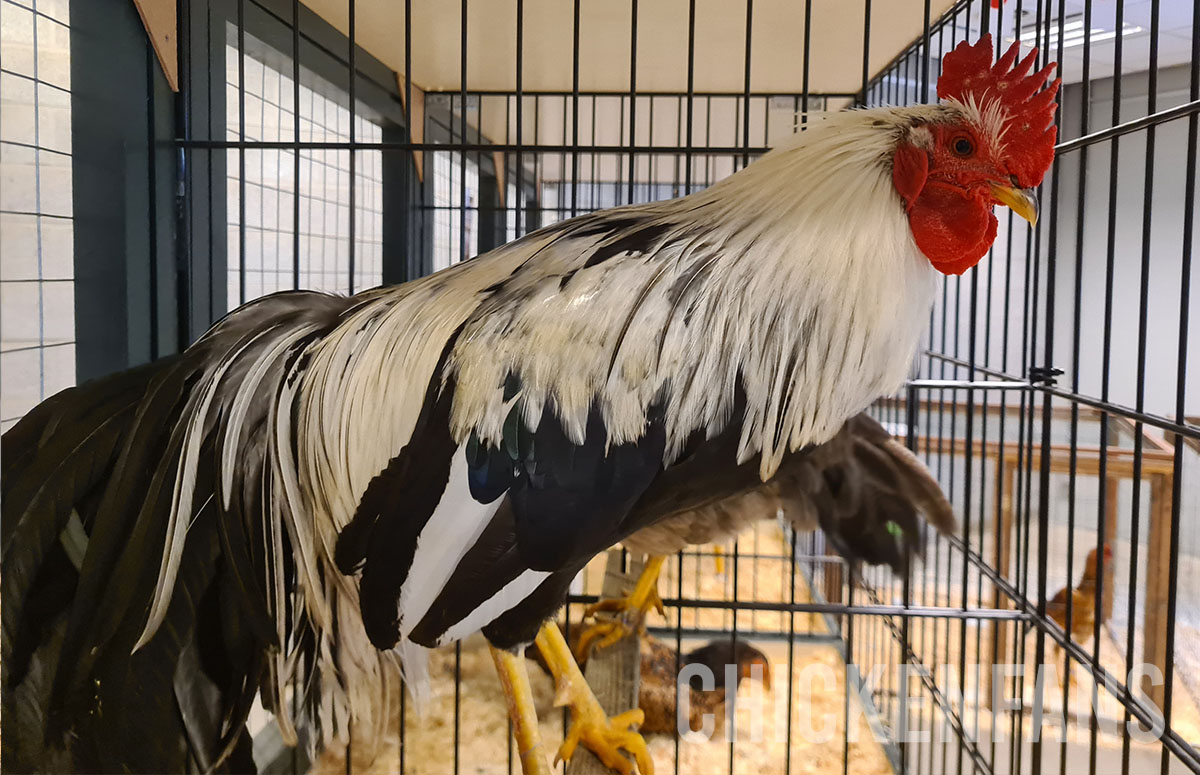
The Shoukoku (Shōkoku) is one of Japan’s oldest and most elegant chickens. Roosters have a flowing train of tail feathers that can stretch over a meter, standing proud. Once prized in cockfights, now cherished as ornamental game fowl, the Shoukoku is a direct link to Japan’s Heian era.
Key takeaways:
- extremely long tail feathers (often over 1 meter) and rich saddle hackles
- ancient Japanese breed, introduced from China in the Heian period (794–1192)
- declared a Natural Monument of Japan in 1941
- still bred in Kyoto and Mie Prefectures
- kept for ornamental and cultural value
| Eggs | few dozen eggs per year at most |
| Egg Color | Tinted to light brown |
| Egg Size | Small |
| Weight | Rooster ~2.0 kg; Hen ~1.6 kg |
| Hardiness | Hardy, but long tails require clean, dry, and spacious housing |
| Temperament | Calm with humans but roosters can be aggressive toward each other |
| Beginner-friendly | No |
| Color | Black-breasted white (silver duckwing), black-breasted white with brown wing coverts, white, black-breasted red |
Characteristics
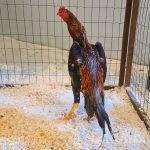
Stand a Shoukoku rooster on the ground and the first thing you notice is the tail: long, layered, and flowing behind him like a banner in the wind. Males often carry tail feathers that exceed 3 feet (1 meter), with equally luxurious saddle hackles draping over the sides.
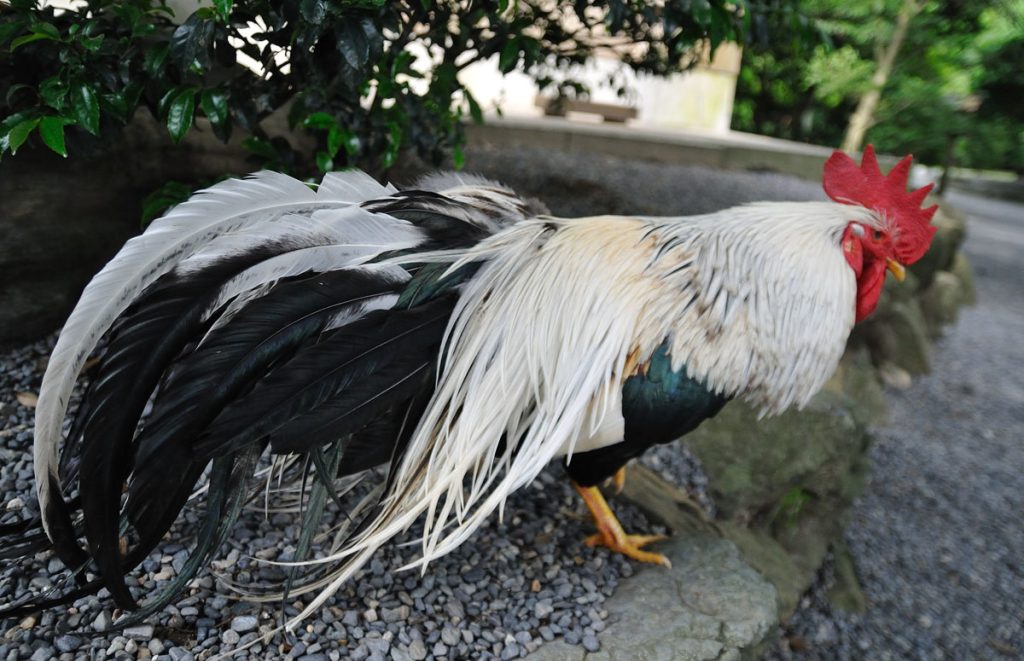
Shoukoku typically come in striking colors: black-breasted white (silver duckwing) is the most iconic, but you’ll also see black-breasted white with brown wing coverts, all-white, or variations close to the Red Junglefowl
The Japanese breed standards call for:
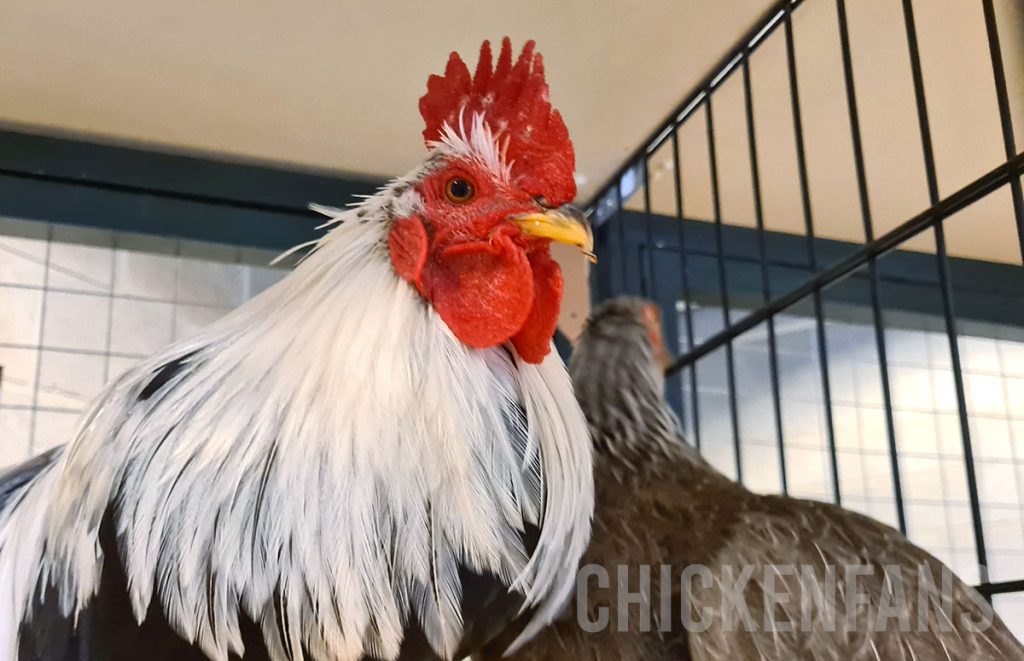
- Comb: Single, upright and even
- Earlobes: Red, contrasting against the face
- Shanks: Yellow
- Weight: Rooster ~2.0 kg, Hen ~1.6 kg
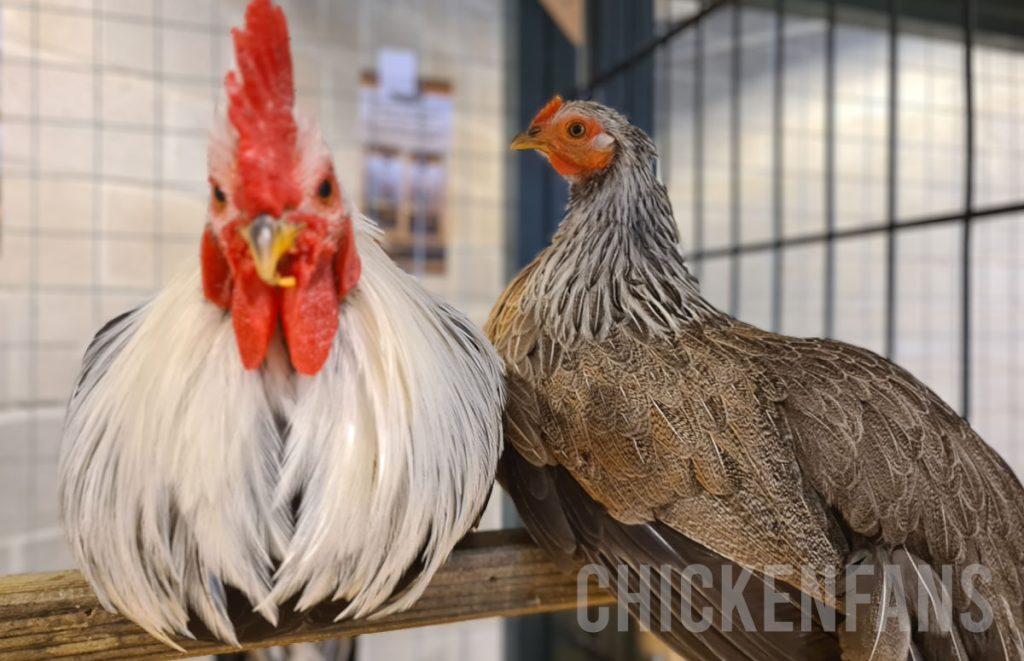
The body retains the egg-type silhouette: slender and upright. But as you can see: enhanced with ornamental flow. Compared to other Japanese gamefowl like Shamo, Shoukoku is much less muscular and more elegant, bred for beauty rather than brute strength.
Personality
Despite their fighting heritage, modern Shoukoku are typically calm toward people.
They are hardy enough for outdoor keeping but require space: those trailing tails are not made for tight pens. If you’re looking for them at shows, check the larger pens.
Roosters may still spar if kept together, so breeders often house them separately.
Origins & Name
The Shoukoku traces back over 1,000 years. Records suggest it was brought from China to Japan during the Heian period (794–1192). By the medieval era, it had already established itself as a prestigious fighting breed and a foundation stock for later Japanese chickens.
In fact, the Shoukoku’s genetics influenced several other native breeds, including the Onagadori (the famous long-tailed fowl) and the Tōtenkō crower.
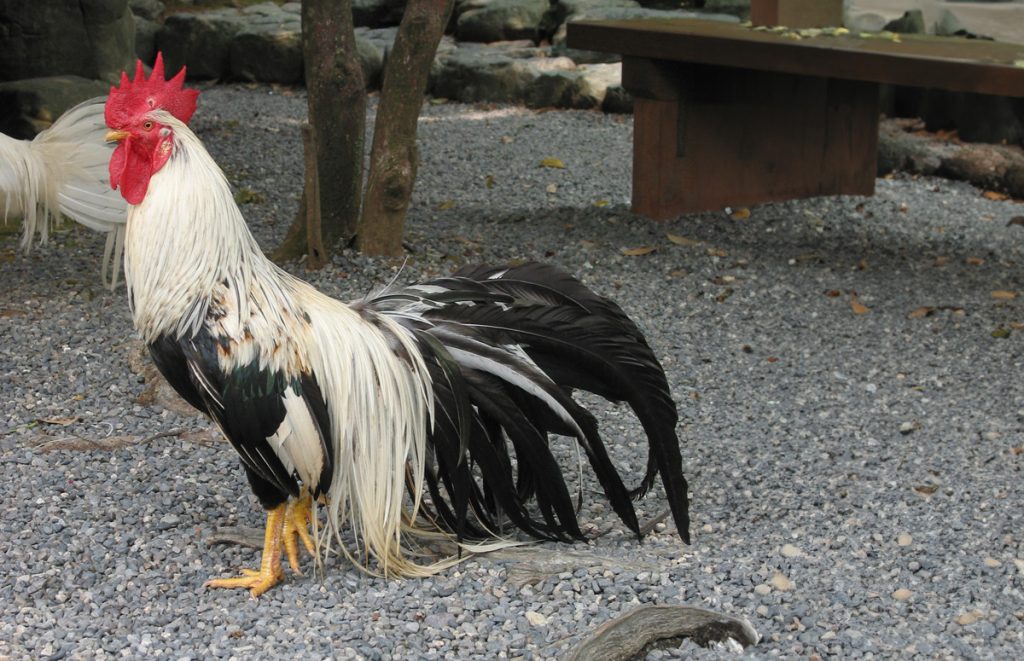
Its name Shoukoku (小国鶏 or Shōkoku) implies refinement and foreign elegance, apt for a bird imported from the continent but deeply rooted in Japanese tradition.
In short, here is a timeline of the Shoukoku breed:
- Heian period (794–1192): Shoukoku imported from China. Quickly adopted as a fighting bird and ornamental fowl in noble courts
- Edo period (1603–1867): Used both in cockfighting and as stock for developing other long-tailed and crowing breeds
- 1941: Officially declared a Natural Monument of Japan, ensuring government protection
- Today: Still bred in Kyoto and Mie Prefectures, mainly by enthusiasts and preservation groups
Shoukoku chickens stand alongside breeds like Koeyoshi and Onagadori as pillars of Japan’s poultry heritage.
Egg Production
Don’t expect much here. Shoukoku hens lay very few eggs: small, tinted, and only seasonally. Historically, they were valued as type birds and cultural icons, not utility layers.
Colors
The Japanese standard accepts several varieties and plumage patterns:
- Black-breasted white (silver duckwing), the most classic
- Black-breasted white with brown wing coverts
- White
- Black-breasted red (rare, but exists)
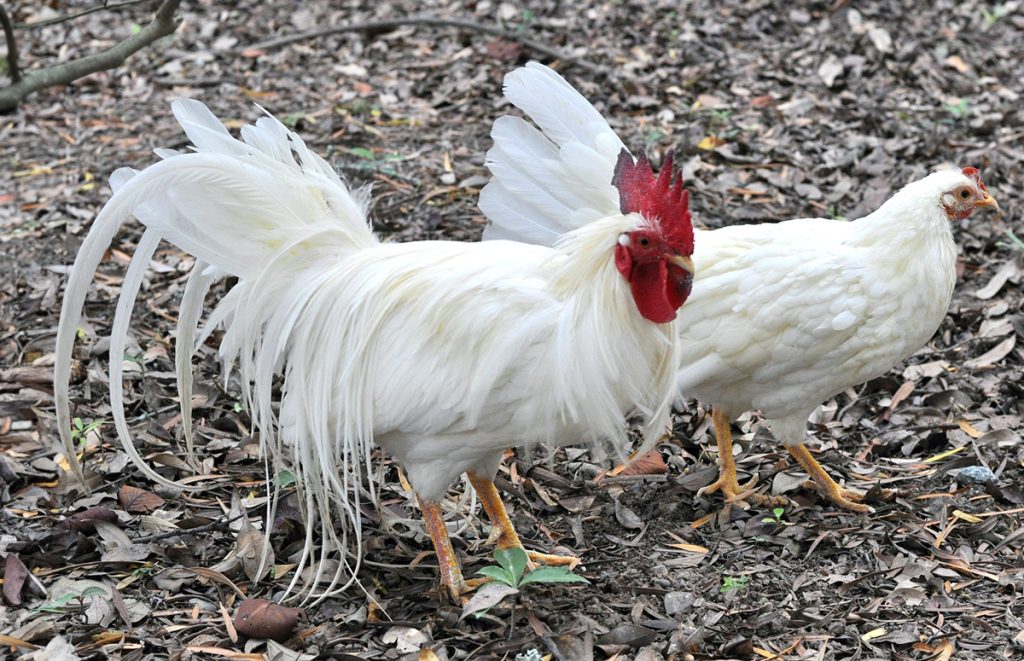
As with other Japanese breeds, type and balance take priority over color in shows: the harmony of tail length, saddle flow, and upright posture defines a true Shoukoku.
Shoukoku vs. Other Japanese Breeds
When you place the Shoukoku next to its Japanese relatives, you can see how it shaped (and was shaped by) the poultry culture of Japan:
| Breed | Main Use | Weight (m/f) | Key Traits | Relation to Shoukoku |
|---|---|---|---|---|
| Shoukoku | Ornamental, once cockfighting | ~2.0 kg ~1.6 kg | Long flowing tail (up to 1 m), elegant saddle hackles, silver duckwing common | The “ancestor” of several Japanese fancy breeds |
| Shamo (Ō-Shamo) | Fighting, meat | ~5.6 kg ~4.9 kg | Upright, muscular, bare breast, aggressive males | Shoukoku is ornamental counterpart; less muscle, more elegance |
| Onagadori | Ornamental | ~1.8 kg ~1.35 kg | Tails grow continuously, reaching 10+ m; never molt | Directly descended from Shoukoku blood |
| Minohiki | Ornamental, fighting origins | ~2.5 kg ~1.8 kg | Upright stance, but with Shoukoku’s long hackles & tails | Hybrid of Shoukoku × Shamo |
| Tōmaru | Long-crower | ~3.75 kg ~2.8 kg | Black plumage, long crows (~15s), rich tail | Believed to include Shoukoku ancestry |
| Jidori (e.g., Gifu, Mie) | Ancient utility, cultural | ~1.8 kg ~1.35 kg | Closer to Red Junglefowl; rustic, simpler tails | Shoukoku is refined successor, larger and more ornamental |
| Koeyoshi / Tōtenkō | Long-crowers | 4.5 kg 3.75 kg (Koeyoshi) ~2.25 kg ~1.8 kg (Tōtenkō) | Extremely long crows; upright with ornamental tails | Shoukoku related via aesthetic traits, not direct ancestry |
Genetics
Genetic studies cluster the Shoukoku close to the Jidori and Shamo groups. Its bloodlines influenced the creation of multiple long-tailed breeds, showing its role as a genetic bridge between ancient imports and the iconic Japanese ornamental chickens.
Microsatellite DNA profiling confirms Shoukoku carries unique markers, reinforcing its long, separate history among Japan’s Natural Monument breeds.
The key visible traits of Shōkoku and related breeds are explained by well-studied genetic loci:
- Comb type: controlled at the R1 locus, single comb allele is dominant
- Earlobe color: regulated by the O locus, red is dominant over white
- Leg color: depends on W+ (white skin) and Id (inhibitor of dermal melanin), both together produce yellow shanks
- Feather length: influenced by multiple genes, Onagadori carries the nm (non-molting) allele, allowing extreme tail growth
- Plumage color: shaped by the sex-linked S (silver) allele, with the e⁺ (wild type) allele at the E locus providing the base color pattern
Summary
The Shoukoku is Japan’s ancient elegance fowl: long-tailed, refined, and steeped in history. Once a warrior in the cockfighting ring, it now survives as a cultural treasure, walking proof of Japan’s deep poultry heritage.
If you want to find out more about Japanese game fowl breeds, check out our articles on the Yamato Gunkei chicken, the Shamo, the Kyshiu Chibi, the Yakido, the Shoukoku chicken, or the Ko Shamo.